
Energy and industry without the trade-off
Space-based solar power, fuel from Moon and asteroid resources and a growing space economy let energy, work and industry grow without conflicting with the environmental goals.
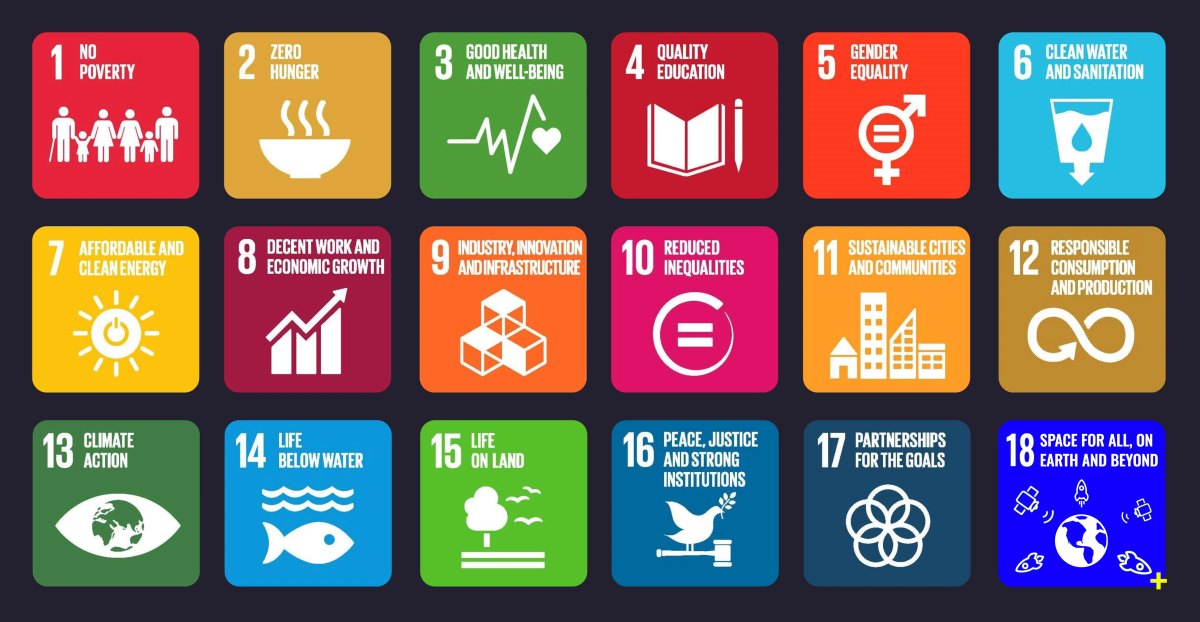
The UN 2030 Agenda defines 17 Sustainable Development Goals — yet none specifically addresses space and its essential role in humanity’s sustainable future. Together with a global coalition of 120+ organizations, Space Renaissance International proposes an 18th SDG: Space for All on Earth & Beyond, because achieving and sustaining the other seventeen goals will depend on humanity’s ability to responsibly expand the domain of life, knowledge, resources, and opportunity beyond Earth.
The Space 18th SDG is a proposal by SRI and its coalition partners. It is not an officially adopted UN Sustainable Development Goal.

The 3rd World Congress puts the 18th SDG among SRI’s twelve priorities.
SRI and its coalition partners present the proposal at the 66th COPUOS session in Vienna.
65 space entities hold a session in New York during the UN General Assembly.
A hybrid workshop at UN Plaza 777 and a side event at the Consulate General of Jamaica.
A side event at the COPUOS Legal Subcommittee in April and a presentation at COPUOS 69 in June.
The 18th SDG calls for civilian-led space development: human communities living and working in outer space, to expand and multiply benefits to all the peoples of Earth.
The 2030 Agenda was adopted in 2015 and conceived during the traditional aerospace age, when reaching orbit was very expensive — so outer space was left out as a dimension of sustainable development. Reusable rockets have since cut that cost dramatically. SRI proposes updating the Agenda accordingly, and starting civilian space development before 2030.
Space science and technology have supported social and environmental goals on Earth for many years: satellites watch over the climate, oceans, forests and crops, connect schools and clinics, and guide transport and rescue. Civilian space development takes this further, so that all seventeen goals become truly sustainable instead of competing with one another.
Space-based solar power, fuel from Moon and asteroid resources and a growing space economy let energy, work and industry grow without conflicting with the environmental goals.
Progressively relocating heavy industry off Earth relieves the planet’s environment, so that its green lungs and seas can regenerate.
Development is a universal civil right. A material base beyond Earth makes growth more inclusive and reduces the reasons for resource wars and conflicts.
Individuals sign the petition; organizations join the coalition as co-promoters; sponsors help carry the proposal to the UN.
Add your name to the call to include an 18th SDG in the UN 2030 Agenda.
Sign on change.orgSpace organizations, universities and associations can become co-promoters of the proposal.
Join as an organizationSupport the side events, travel and materials that bring the proposal to COPUOS and the UN.
SponsorSRI’s side event of 16 April 2026 in Vienna on space as a cross-cutting enabler of sustainable development, convened by Dr Gülin Dede.